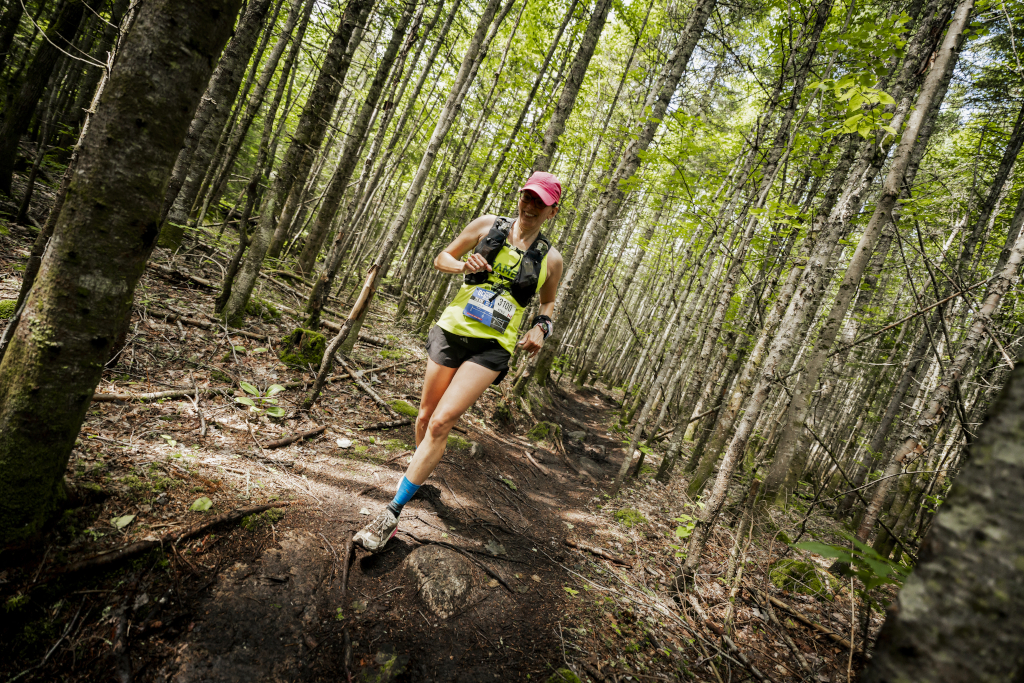
Fourteen weeks before the Toronto Waterfront marathon. I ran my most challenging race to date: the QMT25, a 25K technical trail race in Quebec, with over a thousand meters elevation gain. Achilles tendons on both sides protesting every step. But it was just the beginning of a tough season. While climbing those steeped hills, I thought of my Achilles bothering me again a week later.
Thirteen weeks to go. With those same Achilles tendons screaming at me, I finished ENDURrun Sport, a staged race totalling 80km divided into eight stages in 8 days. How did I do it? Thanks to my stubborn mindset, the book Endure, my running buddies, and lots and lots of KT tape.
Eleven weeks to go. I was paying the price. No wonder my Achilles tendons hurt, so I went through physiotherapy sessions. At that stage, all I could manage were short and slow runs with lots and lots of swimming.
Seven weeks to go. I just got back into the swing and increased my distances to 13k. With 5 weeks to go, I finally hit 23k. By then, every time I went out for a run I spent at least 90 minutes out there.
Three weeks to go. I was in a groove when I caught a cold that my kids brought from school. I couldn't run, I couldn't swim, but I expected to go for another long run, I just didn't know how.
Two weeks to go. I was finally getting back on my feet for a 21k run, but my body didn't agree. I did it anyway, only to see my heart rate through the roof! My body was still recovering, so I took it as a sign to relax.
On race week. My husband is an experienced runner and noticed that I was uncertain about my preparation. So, he suggested a test to figure out the race pace that matches the preparation. The goal was to find a pace I could sustain during the entire race. The next day, I went for a 10k run and switched to nose breathing for 100m every 2km. If I felt the urge to breathe through my mouth before the 100m, I was too fast; otherwise, I could lower my pace until I found the sweet spot where the nose breathing for 100m felt just right. I found that pace and returned home feeling like this marathon was still possible. It was slow, but that's where I got with the training I managed to do through injuries, colds, work, family, trips, vacations, and life in general.
The Race
Race day. It was easy to keep the planed pace in the first 5k. I was fresh and my mind kept begging me to speed up. I couldn't let it fool me. I saw my family and friends cheering for me at 5k, and I naturally sped up again. So, I kept reminding myself to slow down until I got it right without much thinking.
I planned to meet my family again at the 21k mark. I wanted to arrive there thinking, "Ok, let's run another half marathon!", but I knew I would speed up, excited with them, and that's what happened. After hugs and kisses, and with all the excitement from the cheering and music, I sped up, and, again, I had to remember to slow down.
At 30k, my mind couldn't resist to tell me "Remember, it's here where you hit the wall. You should hit it anytime now!" but somehow, I didn't! Not this time! I was feeling good, keeping my pace steady and running. The 33k was a big mark for me, but I wasn't fooled. I actually saw the wall, it was right there, but this time I was pushing, instead of hitting it.
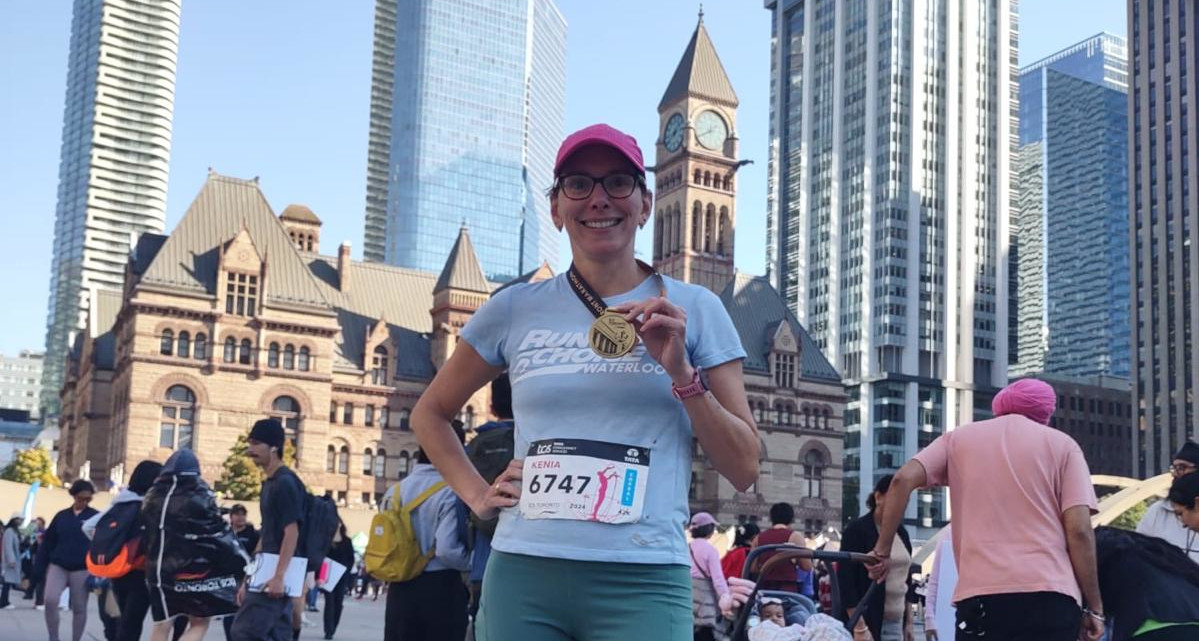
I took my last nutrition around 37k and hoped it was enough to bring me to the finish line without walking. The remaining distance was no shortage of challenge though, like a big hill at 39k. But instead of bringing me down, I was happy I could keep my steady pace uphill at that point in the race. 3k more to go. 2k more to go. Almost there! One more uphill to the finish, and with tears in my eyes, I crossed the finish line. I didn't walk, I ran an entire marathon for the first time!
Stats
- Time: 04:51:50
- Average Pace: 6:54/km
- Average Heart Rate: 161 bpm
My Experience With The Wall
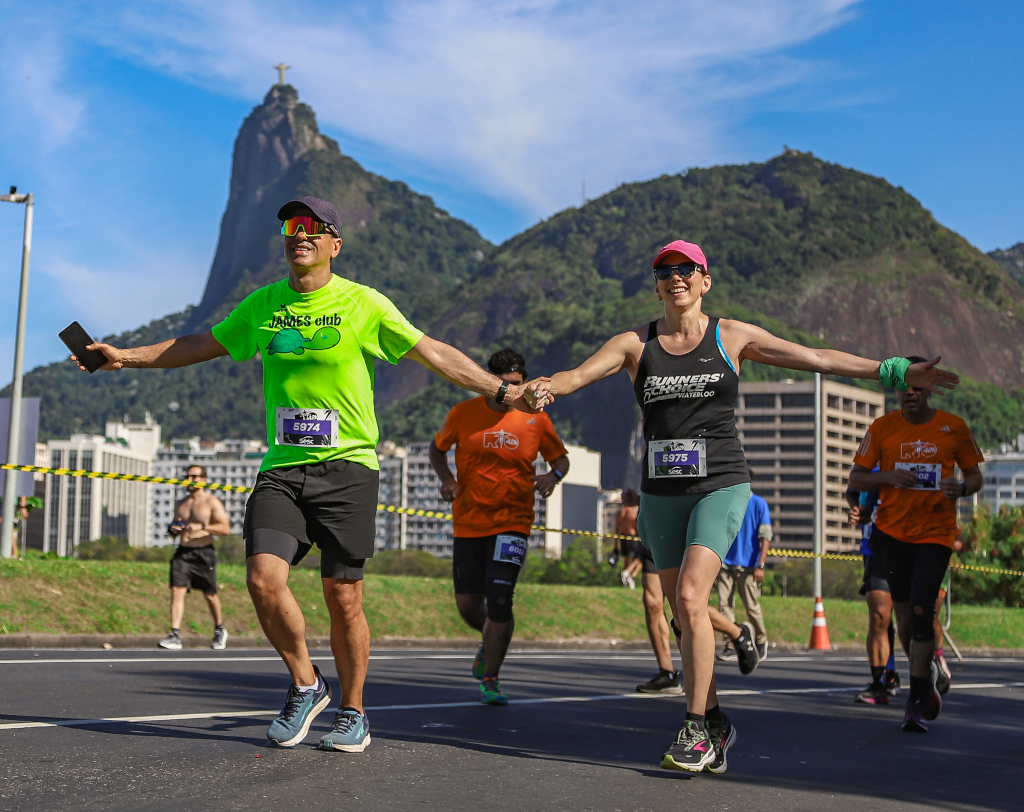
When I ran my first marathon, The Marine Corps in Washington DC., I slowed down and started walking. In my second marathon, in Rio, I kept trying to run but couldn't keep it up for too long.
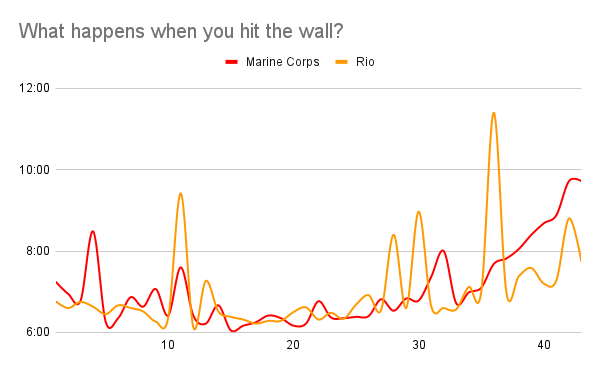
What's the difference between hitting the wall and pushing the wall? Instead of slowing down or walking, I kept a steady pace until the end.
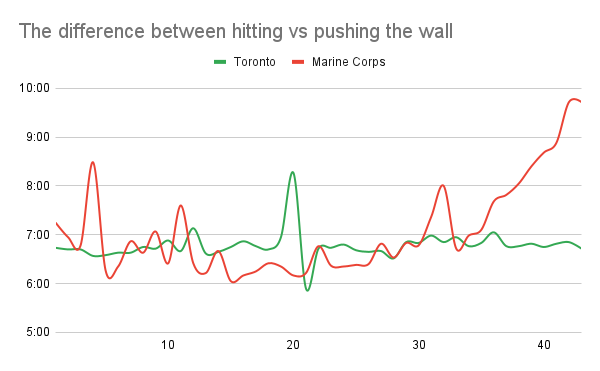
The one spike in Toronto is called love. The moment I saw my family, I stopped for kisses and sped up. Then, I reminded myself to go back to my pace.
How did I feel after almost 5 hours of pounding the pavement? No new injuries! In fact, I felt great! No hip pain, no major Achilles pain, just the satisfying ache of a job well done.